Cold storage runs on thin margins and unforgiving physics. Every watt you can avoid turns into capacity you can redeploy or dollars you can keep. Over the years managing refrigerated storage portfolios and auditing third-party sites, I’ve learned that the best savings come from dozens of small, disciplined habits, plus a few well-timed capital upgrades. Whether you operate a single cold storage facility, a refrigerated storage hub on the edge of a metro area, or a cold storage facility in a hot market like San Antonio TX, the playbook is similar: control heat gain, tame infiltration, run equipment at its sweet spot, and respect the constraints of your product.
Where the load really comes from
Energy in a cold warehouse primarily pays for removing heat, and that heat gets in through four routes: conduction through the envelope, infiltration from door openings and pressure leaks, internal gains from people and equipment, and product load. Product load is non-negotiable if you run at capacity, but the other three often hide big opportunities.
In conduction, the envelope’s insulation value and the quality of thermal breaks dictate how quickly ambient heat finds its way inside. Thin or moisture-damaged insulation in a roof can double your heat gain even if the walls look pristine. Infiltration is the wildcard. One badly sealed dock leveler or a roll-up door left cracked open can spike compressor run hours for the entire shift. Internal gains add up in subtle ways. A few forklifts, high-bay lights, and a cluster of battery chargers can dump heat and humidity that eventually becomes refrigeration load.
Different climates color the problem. If you run refrigerated storage in San Antonio TX, you fight high ambient temperatures and long cooling seasons, plus humidity that wants to condense on every surface. In a mild climate, shoulder seasons help, but poor door discipline can erase that advantage.
Tightening the building envelope without shutting down operations
You don’t have to empty the building to make meaningful envelope improvements. Plan work during low-volume windows, pick zones, and move quickly.
Start with the roof. Infrared scans during early morning temperature differentials often reveal wet insulation panels under membrane roofs. Wet insulation can drop from R-30 to single digits. Replacing those wet sections and ensuring vapor barriers are continuous typically produces measurable kW reductions. When roof work is out of reach, even reflective roof coatings can reduce roof surface temperatures by tens of degrees in summer, which reduces conduction into the plenum and suction line heat pickup.
Wall and floor interfaces are notorious for thermal bridging. Metal Z-girts, uninsulated pilasters, and door frames bypass insulation. Retrofitting thermal breaks at door frames and dock interfaces often pays back faster than wall-panel replacement. An experienced contractor will use insulated shrouds and brush seals that flex with traffic without tearing. On the floor, monitor slab temperatures and watch for heaving. If the underslab insulation or vapor barrier is compromised, you might see frost rings or uneven floor temperatures that signal energy losses and future maintenance headaches. Probing a few suspect locations beats learning the hard way when a floor warms up and moisture enters the box.
The discipline of doors, vestibules, and airflow
Doors do more damage to energy budgets than any other operator behavior. You cannot fix it with signs alone. The solution is part engineering, part culture.

For high-traffic freezers and coolers, vestibules with properly sized air curtains or strip curtains limit infiltration. The key is pressure management. If your evaporator fans pull too hard and your relief vents aren’t balanced, air will whistle in under doors no matter what you install. I’ve stood in vestibules where air curtains worked perfectly until the condensing units ramped, then negative pressure turned them into decorative features. Schedule a pressure test. Measure pressure differentials between rooms and the ambient dock. Aim for neutral to slightly positive pressure in higher-temperature rooms relative to colder rooms, and ensure the coldest rooms never sit under negative pressure relative to warmer adjacent spaces.
It’s worth training operators to “stage the door.” Instead of opening a door fully for a small load, set the stops for partial openings. For roll-ups, program slow open and fast close. If you use strip curtains, maintain them. Tattered strips become an invitation to infiltration. When you switch from strip curtains to high-speed fabric doors, monitor how lift truck drivers behave. Fast doors can encourage rapid cycling, which can be good as long as the door stays closed between passes.
One more subtlety: ceiling fans or destratification fans in the dock or ante-room can stabilize temperatures and reduce humidity spikes that migrate into cold spaces. If humidity is under control before air reaches the evaporators, coil defrost frequency drops, and you save on both energy and product dehydration.
Lighting and heat load trade-offs
LEDs are standard, but audits still find old metal halides or fluorescents in corners and mezzanines. Lighting is about more than watts per square foot. Every watt of light inside a cold room becomes heat the refrigeration system must remove. Swapping a 400 W metal halide for a 150 W LED never just saves 250 W at the panel. It also trims refrigeration load downstream.
The less obvious lever is controls. Motion sensors and zoning in aisles can cut run hours by half or more. If you’ve delayed sensors because early generations were unreliable in cold or triggered erratically with forklifts, the newer generation handles low temperatures better and allows time delays that prevent strobing. In picking aisles, aim for 20 to 30 minute occupancy windows that reflect real workflows, not the default five-minute setting that looks good on paper but frustrates staff.
Evaporators and defrost, the heart of efficiency
Evaporator coils do the hard work. Foul them with frost or dust and everything downstream suffers. The trap is over-defrosting. Every unnecessary defrost wastes energy by heating the coil and interrupting the most efficient operating condition, which is a clean, cold coil.
Time-based defrost schedules are the blunt instrument many facilities inherit. Switch to demand defrost if your control platform can support it. Technologies vary, but a common approach uses temperature differential and coil pressure to trigger defrost only when ice formation reaches a defined threshold. A well-tuned system can cut defrost events by 30 to 50 percent. In a busy refrigerated storage facility with high infiltration, demand defrost often pays back within a year.
Airflow matters plenty. Verify fan curve and set speeds to match load. If fans run full speed all day to satisfy peak conditions that occur for two hours, you are throwing away energy. Variable speed drives on evaporator fans can reduce power by the cube of speed reductions. A 20 percent speed reduction can shave roughly 50 percent fan power, and if you maintain air throw across the aisle, product temperature uniformity stays inside spec. Expect to calibrate speed schedules per room type: produce coolers like a different profile than ice cream freezers.
Coil cleaning is non-negotiable, but avoid the scorched-earth approach. Aggressive chemicals and high-pressure wands can bend fins, which reduces heat transfer for years. Gentle foaming agents, lower pressure, and fin combs take longer yet protect performance. If you track coil delta-T over time, you can target cleaning to the units that actually need it.
Compressors, condensers, and the control envelope
Compressors have a sweet spot, and they will tell you if you listen. I keep a simple rule of thumb: run fewer compressors harder rather than many compressors loafing. Part-load efficiency tends to be worse unless you have state-of-the-art variable speed or digital capacity control across the rack. Staging logic should minimize short cycling. Data helps. Install hour meters or pull runtime data from the existing PLC. If you notice rapid on-off cycling on mild days, adjust your band and time delays.
Floating suction and floating head pressure control still deliver. By allowing suction pressure to rise when possible, you reduce compressor lift and power. The degree you can float depends on product requirements and coil sizing. If your product spec allows a slightly higher room setpoint or wider band, consider incremental trials. Even a 1 degree Fahrenheit lift in suction can reduce compressor energy several percent.
On the condenser side, fan speed controls and wetting strategies matter. Adiabatic pads or timed water spray can keep head pressure down during summer peaks, especially valuable in hot climates like San Antonio TX where afternoon head pressures balloon. The trade-off is water use and maintenance. Keep scale down and treat water to avoid fouling. If you dislike water, oversize dry coolers and run variable speed to ride cooler morning air. Either way, clean coil faces matter. A thin film of dust can cost several degrees of approach temperature. If you operate a cold storage facility near me, opt for a seasonal coil cleaning schedule that aligns with local pollen or dust seasons, not just a fixed calendar.
Oil management is another quiet efficiency drain. Poor oil return lowers heat transfer in evaporators and raises compressor discharge temperatures. Regularly review oil levels and returns, and check separators. A few hours spent on oil balance across a rack can eliminate nuisance trips and reduce energy use through more stable compression.
The power of data that operators actually use
Building automation systems are common, but dashboards that drive behavior are rare. Start refrigerated storage San Antonio TX augecoldstorage.com with a handful of metrics that anyone can understand: kWh per pallet month, kW per square foot, door open time by zone, defrost events per day by room, and average suction and head pressures. Post them where supervisors gather.
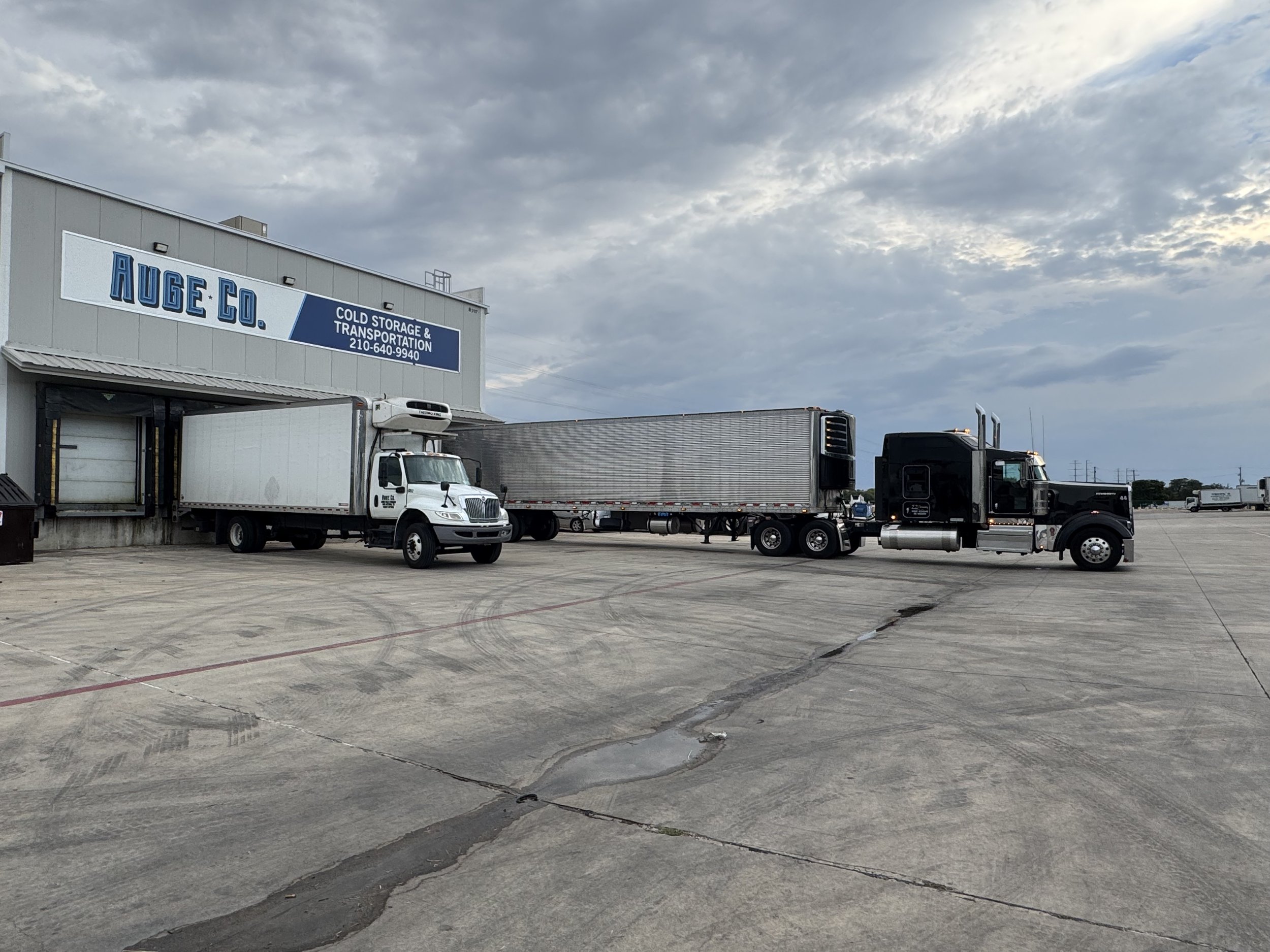
When I worked with a refrigerated storage near me that struggled with high summer bills, we set a simple target: a 15 percent cut in door open time in the dock. We installed magnetic reed switches and tracked time by shift. No reprimands, just visibility and a modest incentive for the best crew each month. Door time dropped 18 percent in six weeks. Compressor runtime followed.
Don’t forget alarms that matter. Flooding operators with nuisance alerts leads to filters and silence. Tune alarms to catch the few things that cause energy pain: abnormally long defrosts, sustained negative pressure in a cold room relative to adjacent spaces, frequent compressor short cycles, and high approach temperatures at condensers.
Dehumidification as an energy strategy, not a comfort feature
Humidity control is not cosmetic. Moisture that enters a cold room turns into frost that drives defrost frequency and blocks airflow. If you can stop humidity at the dock, you win twice. Desiccant dehumidifiers or DX dehumidification systems in ante-rooms can trim ice build-up on coils, reduce door fog, and lower slip hazards. Sizing matters. Undersized units make noise and little else. Properly laid out, you should see frost decrease on door frames within days, and your defrost intervals will stretch.
Some sites overshoot and dry the dock so much that carton fibers brittle out, which causes handling issues. Aim for a dock relative humidity that stays in the 40 to 55 percent range depending on product and traffic. Log the dock dew point and compare it to the coldest surface temperature in your path. Your goal is to keep dock dew point comfortably below those surface temps to prevent condensation and ice.
Free cooling and waste heat, the two overlooked levers
In cooler seasons, you can sometimes run condenser fans at lower speeds and float head pressures down significantly. If your plant has glycol loops or an airside economizer for machine rooms, milk the free cooling window. Even in a warm city like San Antonio, nights and shoulder months offer opportunities. Program the logic to take advantage automatically. No operator should need to guess whether tonight is a free-cooling night.
On the flip side, heat reclaimed from compressors can preheat defrost hot gas, warm offices or battery rooms, or serve under-slab heating to keep floors stable. Waste heat often gets treated as an afterthought. A simple brazed-plate exchanger and a small pump loop can recover enough heat to eliminate electric unit heaters in adjacent spaces. Keep control logic conservative. Priority always goes to refrigeration stability. When the system doesn’t need heat, it should bypass without causing head pressure to spike.
Product temperature strategy and setpoints
The safest energy is the energy you don’t need to use because your target temperatures match reality. Many cold storage facilities inherit setpoints with a few degrees of “insurance.” Insurance has a cost. If the product spec allows a 36 to 38 degree range, and you are holding 33 to 34 degrees all year, try a carefully monitored increase. Instrument the room with calibrated loggers at representative locations and track both air and product core temperatures. Raise setpoints a half degree at a time, hold for a week, and confirm that pull-down after door openings remains acceptable.
The same logic applies to freezers. A -10 degree setpoint when -5 would suffice may be a legacy from an older, underpowered system or a worst-case summer rule that never got revisited after upgrades. Don’t change setpoints casually. Coordinate with customers, document trials, and protect shelf life. Done carefully, setpoint tuning often yields a 3 to 10 percent energy reduction without capital.
Maintenance routines that pay for themselves
Some of the cheapest energy savings live in maintenance details. Replace door gaskets before they rip. Seal dock leveler perimeters with brush seals or inflatable seals instead of letting a black gap inhale humid air for years. Keep condensate drains clear so that water doesn’t spill and freeze, which leads to heat guns and salt that compromise floors and load-in patterns.
Fan belts slip long before they squeal. A belt that is 5 to 10 percent loose reduces airflow and increases coil icing, which shortens time between defrosts. Spend a morning every month checking tension and alignment. When possible, swap to direct-drive EC fans in high-runtime locations. They cost more up front but pay back with lower energy and fewer belt issues.
Filter placement is another quiet win. If your evaporators use filters in dusty docks or load-prep rooms, staff will sometimes remove them during a rush and never reinstall them. A poorly located filter is as bad as no filter. Relocate filters so they can be serviced from safe, convenient positions. If service is easy, it happens.
Smart forklifts, chargers, and traffic patterns
Warehouse vehicles generate heat, and their charging profiles can distort your demand curve. If you operate a cold storage facility in San Antonio TX during summer on a demand tariff, aligning battery charging with off-peak hours or midday solar can flatten your peak. Modern chargers allow scheduling and soft-start functions to avoid large coincident loads.
Li-ion forklifts often run cooler than lead-acid models and reduce ventilation and charging room heat. They cost more but shave internal heat gains and downtime. For mixed fleets, consider zoned traffic routes that keep combustion or high-heat equipment out of the coldest rooms. Every minute a lift idles in a freezer is heat you must pay to remove.
Traffic patterns affect doors. If possible, stage high-velocity routes to use a single high-speed door rather than multiple conventional doors scattered around. Concentrating movement allows you to focus investment on the one opening that gets abused and deliver tighter seals elsewhere.
Utility rates, demand control, and on-site generation
Your refrigeration plant might pull the same energy each day but pay different amounts depending on when it peaks. Many utilities in Texas and elsewhere punish short, sharp peaks with steep demand charges. Automating demand response can save a facility far more than nudging equipment efficiency alone. At the start of a peak pricing window, pre-cool certain rooms slightly within product constraints, then raise setpoints by a fraction to coast. Stagger defrost schedules so multiple large rooms do not defrost concurrently. Slow non-critical fans for a short period. You are shaping load, not starving it.
If you have roof space, solar PV can pair surprisingly well. Peak sun often coincides with peak condenser loads. Even if PV only covers 10 to 20 percent of peak kW, it trims demand charges and steadies head pressure. Battery storage is expensive, but a small system dedicated to ride-through during utility transients can prevent nuisance trips that otherwise require hot restarts and chaotic defrost recovery.
Retrofitting controls without replacing everything
Full control system overhauls are disruptive. You can start small with overlays that read legacy sensors and add smarter logic. Wireless temperature and door sensors cost little and feed data into a lightweight analytics layer. From there, you can implement floating suction, demand defrost, and door alarms before touching compressor starters or VFDs. As capital becomes available, upgrade the highest-hour assets first: evaporator fans and condenser fans generally pay back faster than compressor replacements.
When selecting vendors, prize transparency. Look for open protocols, clear logic, and the ability to export raw data. Black-box systems create dependence and frustration. A good integration partner will pilot in one room, prove savings, and then scale.
A practical sequence for operators to act on
The most successful teams I’ve seen follow a simple sequence that blends quick wins with groundwork for bigger savings.
- Fix what leaks: door seals, dock levelers, and obvious envelope gaps. Verify with a smoke pencil or thermal camera, not just a walk-by. Clean and calibrate: coils, fans, belts, sensors, and setpoints. Log before and after data. Tame doors with behavior and hardware: train drivers, adjust opening speeds, and repair or replace strip curtains and high-speed doors. Optimize defrost and fan speed: implement demand defrost and variable speed on evaporator fans in the worst-offending rooms. Float pressures and schedule intelligently: enable floating suction and head, stagger defrosts, and deploy modest demand management during peak periods.
These steps usually fit inside operating budgets and avoid long shutdowns. After you see the curve bend, layer in larger projects like roof insulation repair, adiabatic condensers, or a control system refresh.
Climate-specific notes for hot and humid regions
For facilities in hot regions, especially a cold storage facility San Antonio TX operators might recognize, humidity management and condenser performance dominate summer bills. Shade and airflow around rooftop or yard-mounted condensers matter. I have watched a fenced condenser yard recirculate its own hot air on still afternoons. Opening the fence panels or adding baffles to direct discharge air up can drop head pressure several psi. That small change shaves compressor kW and reduces nuisance high-head trips during the worst hours.
Consider pre-cooling dock intake air with a small dedicated system or enhanced filtration. Keep door sweeps in office areas tight so conditioned air does not dilute your dock dehumidification. If your refrigerated storage near me sits by a busy road, airborne dust will stick to condenser fins. Increase cleaning frequency during dry months and schedule work early in the day before metal surfaces become too hot to touch safely.
When to replace equipment versus nurse it along
The payback math for replacing versus repairing depends on runtime and utility rates. Compressors with obsolete controls and fixed capacity can be worth replacing if capital is available and you carry heavy load year-round. If the rack runs at low to mid load most of the year, retrofit capacity control first. For evaporators, swapping to EC fans often pays back in two to three years under typical duty cycles, sooner in 24/7 freezers. Condensers are trickier. If the coil surface is undersized for summer peaks and you see chronic high head pressures, replacement or augmentation with adiabatic assist can yield immediate operational relief plus energy savings.
Do not ignore age. Insulation and wiring inside older units degrade. Electrical resistance rises, contactors heat, and failures become more frequent. Track mean time between failures and the cost of emergency service. Sooner or later, the hidden cost of nursing old gear will outweigh the payments on a new, efficient unit.
Safety and food integrity always lead
Energy projects must live under food safety and worker safety. Plan changes with HACCP in mind. If a setpoint trial raises room temperature, document risk mitigation and monitoring. Provide temporary temperature loggers for pallets at the warmest locations. Coordinate maintenance with QA so that coil cleaning agents and procedures are compliant and residues do not contaminate product. For high lifts and condenser cleaning, lockout-tagout rigor saves lives and avoids the kind of incident that derails a program for months.
Finding help and choosing partners
If you are searching online for a cold storage facility near me or a refrigerated storage San Antonio TX provider that already operates efficient plants, ask pointed questions. How do they measure kWh per pallet month? Do they use demand defrost, floating suction, and variable speed across critical fans? Where do they post weekly metrics for staff? Facilities that understand these questions will often have already harvested the obvious wins, which translates into stable pricing and fewer temperature excursions.
When hiring auditors, pick firms that show up with both instrumentation and work boots. A good audit involves measuring pressure differentials at doors, logging coil temperatures through several defrost cycles, and watching how lift drivers behave at peak times. You want practical recommendations that fit your workflows, not a generic binder of best practices that assume you can shut down for two weeks.

The compounding effect of small wins
The thread that runs through all of this is compounding. Fix one leaking dock door, and the coil 80 feet away frosts more slowly, which reduces defrost cycles, which cuts compressor load, which lowers head pressure, which saves fan power and reduces product dehydration. Energy savings multiply when you attack the system rather than a single component.
Cold storage never truly goes on autopilot. Products change, seasons shift, staff turns over, and equipment ages. The operators who get ahead treat energy as a daily craft, not a periodic project. They walk the floor when the sun is high, run their hands along door frames to feel for drafts, graph suction pressure by day of week, and talk to the forklift lead about what actually slows them down. That attention, backed by targeted hardware and smarter controls, is what keeps a refrigerated storage facility efficient, whether it is a single cooler behind a small grocer or a multi-temperature cold storage facility serving a sprawling metro.
Business Name: Auge Co. Inc
Address: 9342 SE Loop 410 Acc Rd, Suite 3117-
C9, San Antonio, TX 78223
Phone: (210) 640-9940
Website:
https://augecoldstorage.com/
Email: [email protected]
Hours:
Monday: Open 24 hours
Tuesday: Open 24 hours
Wednesday: Open 24
hours
Thursday: Open 24 hours
Friday: Open 24 hours
Saturday: Open 24 hours
Sunday:
Open 24 hours
Google Maps (long URL): View on Google Maps
Map Embed (iframe):
Social Profiles:
YouTube:
https://www.youtube.com/channel/UCuYxzzyL1gBXzAjV6nwepuw/about
Auge Co. Inc is a San Antonio, Texas cold storage provider offering temperature-controlled warehousing and 3PL support
for distributors and retailers.
Auge Co. Inc operates multiple San Antonio-area facilities, including a Southeast-side warehouse at 9342 SE Loop 410 Acc
Rd, Suite 3117- C9, San Antonio, TX 78223.
Auge Co. Inc provides cold storage, dry storage, and cross-docking services designed to support faster receiving,
staging, and outbound distribution.
Auge Co. Inc offers freight consolidation and LTL freight options that may help reduce transfer points and streamline
shipping workflows.
Auge Co. Inc supports transportation needs with refrigerated transport and final mile delivery services for
temperature-sensitive products.
Auge Co. Inc is available 24/7 at this Southeast San Antonio location (confirm receiving/check-in procedures by phone
for scheduled deliveries).
Auge Co. Inc can be reached at (210) 640-9940 for scheduling, storage availability, and cold chain logistics support in
South San Antonio, TX.
Auge Co. Inc is listed on Google Maps for this location here: https://www.google.com/maps/search/?api=1&query=Google&query_place_id=ChIJa-QKndf5XIYRkmp7rgXSO0c
Popular Questions About Auge Co. Inc
What does Auge Co. Inc do?
Auge Co. Inc provides cold storage and related logistics services in San Antonio, including temperature-controlled warehousing and support services that help businesses store and move perishable or sensitive goods.
Where is the Auge Co. Inc Southeast San Antonio cold storage location?
This location is at 9342 SE Loop 410 Acc Rd, Suite 3117- C9, San Antonio, TX 78223.
Is this location open 24/7?
Yes—this Southeast San Antonio location is listed as open 24/7. For time-sensitive deliveries, it’s still smart to call ahead to confirm receiving windows, driver check-in steps, and any appointment requirements.
What services are commonly available at this facility?
Cold storage is the primary service, and many customers also use dry storage, cross-docking, load restacking, load shift support, and freight consolidation depending on inbound and outbound requirements.
Do they provide transportation in addition to warehousing?
Auge Co. Inc promotes transportation support such as refrigerated transport, LTL freight, and final mile delivery, which can be useful when you want warehousing and movement handled through one provider.
How does pricing usually work for cold storage?
Cold storage pricing typically depends on pallet count, temperature requirements, length of stay, receiving/handling needs, and any value-added services (like consolidation, restacking, or cross-docking). Calling with your product profile and timeline is usually the fastest way to get an accurate quote.
What kinds of businesses use a cold storage 3PL in South San Antonio?
Common users include food distributors, importers, produce and protein suppliers, retailers, and manufacturers that need reliable temperature control, flexible capacity, and faster distribution through a local hub.
How do I contact Auge Co. Inc for cold storage in South San Antonio?
Call (210) 640-9940 to discuss availability, receiving, and scheduling. You can also
email [email protected]. Website: https://augecoldstorage.com/
YouTube: https://www.youtube.com/channel/UCuYxzzyL1gBXzAjV6nwepuw/about
Google Maps: https://www.google.com/maps/search/?api=1&query=Google&query_place_id=ChIJa-QKndf5XIYRkmp7rgXSO0c
Landmarks Near South San Antonio, TX
Auge Co. Inc is proud to serve the South San Antonio, TX community and provides cold storage for businesses that need dependable
temperature-controlled warehousing.
If you’re looking for cold storage in South San Antonio, TX, visit Auge Co. Inc near Brooks City Base.
Auge Co. Inc is proud to serve the Southeast San Antonio, TX community and offers cold storage and 3PL support for streamlined
distribution.
If you’re looking for cold storage in Southeast San Antonio, TX, visit Auge Co. Inc near Toyota Motor Manufacturing Texas.
Auge Co. Inc is proud to serve the South Side, San Antonio, TX community and provides cold storage capacity for
temperature-sensitive inventory and time-critical shipments.
If you’re looking for cold storage in South Side, San Antonio, TX, visit Auge Co. Inc near Stinson Municipal Airport.
Auge Co. Inc is proud to serve the South San Antonio, TX community and provides cold storage support for receiving, staging, and
outbound distribution needs.
If you’re looking for cold storage in South San Antonio, TX, visit Auge Co. Inc near South Park Mall.
Auge Co. Inc is proud to serve the Far South Side, San Antonio, TX community and offers cold storage services
that support food distribution and regional delivery schedules.
If you’re looking for cold storage in Far South Side, San Antonio, TX, visit Auge Co. Inc near Palo Alto College.
Auge Co. Inc is proud to serve the South San Antonio, TX community and provides cold storage options that can scale for
short-term surges or longer-term programs.
If you’re looking for cold storage in South San Antonio, TX, visit Auge Co. Inc near Mitchell Lake Audubon Center.
Auge Co. Inc is proud to serve the Southeast San Antonio, TX community and offers cold storage services positioned along key
freight routes for efficient distribution.
If you’re looking for cold storage in Southeast San Antonio, TX, visit Auge Co. Inc near Frost Bank Center.
Auge Co. Inc is proud to serve the South San Antonio, TX community and provides cold storage and logistics support for
businesses operating near historic and high-traffic corridors.
If you’re looking for cold storage in South San Antonio, TX, visit Auge Co. Inc near San Antonio Missions National Historical Park.
Auge Co. Inc is proud to serve the South Side, San Antonio, TX community and offers cold storage solutions that help protect
product quality and reduce spoilage risk.
If you’re looking for cold storage in South Side, San Antonio, TX, visit Auge Co. Inc near Mission San José.